Here is a scenario most advisory desks have lived through. A client signs up on a Tuesday, pays, and starts receiving research. Three weeks later their KYC is rejected. Now the desk has a paying, active client with no valid KYC, and two bad options: keep serving them while it is fixed, or suspend them and refund.
The cause is almost never fraud. It is a name.
Why the name is the problem
When people type their name into a form, they type it the way they say it. That often differs from how it appears on the official record:
- An initial is expanded ("R. Kumar" becomes "Rajesh Kumar"), or a full name is shortened.
- A middle name, or a father's name, is left out.
- A spelling is slightly different: one letter, a doubled consonant, a space.
Each of these is enough for a KYC to bounce when it is matched later. And because the match happens downstream, the problem surfaces long after onboarding has "finished".
Check at entry, then fill the form from the record
The fix is simple to describe:
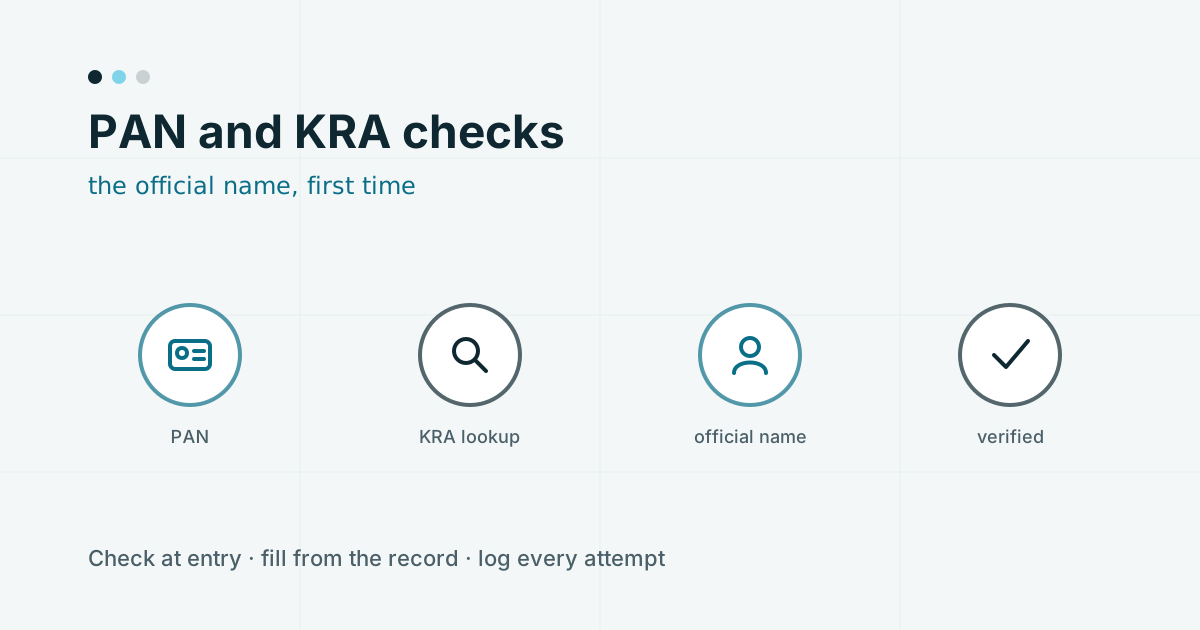
- When the client enters their PAN, verify it against the KRA record immediately.
- Take the official name from the response and fill it into the form for them.
- Do not let the client retype it.
The client never transcribes their own name, so there is nothing to mismatch. The check happens while they are still on the page, so any genuine problem is resolved in the moment, with the client present, rather than by email three weeks later.
Whose KRA credentials?
PAN and KYC lookups go through a KYC Registration Agency. Many Indian advisory businesses are enrolled with one or more KRAs and have their own credentials and point-of-service code.
A detail that matters more than it seems: the lookup should run on your credentials, not your software vendor's. If it runs on the vendor's, the vendor sits in the middle of your KYC process. The verification trail, which is part of your compliance record, is in someone else's name. And if you change vendors, your history goes with them.
Good platforms let you add your own KRA credentials, and often to switch between test and live environments per registry, so you can trial the flow before going live.
Two kinds of "no"
Not every failed check means the same thing, and treating them the same causes avoidable friction.
A confident negative. The PAN does not exist, or the record clearly belongs to someone else. This should stop the flow, with a clear message.
No answer. The KRA timed out, was down for maintenance, or the client's record has not been created yet because they are new to the market. This is not evidence of a problem. The client should usually be allowed to continue, and the account flagged for your team to follow up.
Building this distinction in prevents the worst outcome: a genuine client abandoning sign-up because of an outage they had nothing to do with.
Make the flagged-for-follow-up list visible to whoever handles operations each morning. A flag nobody reads is the same as no flag.
The document, not the API response, is the evidence
A successful API call tells you the check passed at that moment. It is not the artefact you will be asked to produce. What you need on file is the KYC record or document itself.
So gate activation on the document existing. If the lookup succeeded but the document has not been fetched or generated yet, the client waits until it has. In practice this delays a small number of clients by minutes. In exchange, you never have an active client with an empty file.
Log every attempt
Keep a record of every verification attempt, not just the successful ones: when it ran, for which PAN, on which credentials, and what came back. Failed and inconclusive attempts are often the most useful records you have when a client later asks why their sign-up took two days, or an auditor asks how you handled a mismatch.
Edge cases worth deciding in advance
Most clients pass straight through. The ones who do not tend to fall into a few familiar groups, and it helps to decide how you will handle each before it happens at 9:15 on a Monday:
- New to the market. A first-time investor may not have a KRA record yet. Decide whether you will onboard them and complete KYC through a separate route, or ask them to come back once their record exists.
- Name changes. A client who changed their name after marriage may have a KRA record in one name and a bank account in another. The KRA name should be the one on your agreement and invoices; note the other name on the client record.
- Non-individual clients. HUFs, companies and partnerships have their own PANs and KYC requirements. Make sure your flow does not force them through an individual-only path.
- Typos in the PAN itself. A client who mistypes one character may get someone else's record, or none. Showing the returned name and asking "Is this you?" catches this immediately.
Writing these down as a one-page operating note for your team saves a surprising amount of time, and gives you a consistent answer when a client asks why they were treated a particular way.
Re-verifying existing clients
If you already have clients who were onboarded before you checked PANs against the KRA, consider running a one-time check across the whole base. It will surface the mismatches that are waiting to cause a rejection, on your schedule rather than the KRA's. Handle the results like any other inconclusive check: a list for your team, worked through over a few weeks.
What it looks like end to end
A well-built PAN and KRA step looks like this from the client's side:
- They enter their PAN.
- A moment later, their official name appears in the form.
- They confirm it and carry on.
From the desk's side:
- The lookup ran on the firm's own credentials.
- The response and the time are logged.
- The KYC document is fetched and stored against the client.
- Activation waits until that document exists.
- Anything inconclusive appears on a follow-up list.
None of this is complex. It is just easy to skip one piece, and the missing piece is always the one that costs a refund three weeks later.
Checklist
- PAN verified against the KRA record at the point of entry
- Official name filled from the response, not retyped
- Lookups run on your own KRA credentials
- Clear distinction between a mismatch and no answer
- Inconclusive checks flagged to a named person
- Activation gated on the KYC document existing
- Every attempt logged with time and outcome
KRA processes and KYC requirements are set by SEBI and the KRAs and change over time. Treat this as practical guidance and confirm current requirements with your KRA and compliance adviser.
How Mintants handles this
During client onboarding on Mintants, the PAN is checked against the KRA record using your own KRA credentials, and KYC is collected as part of the same flow. The signed agreement and KYC are filed against the client record, and each step is written to the audit trail with its time and outcome.
Book a walkthrough to see the flow on your own brand, or read what compliant onboarding should mean for the wider picture.