
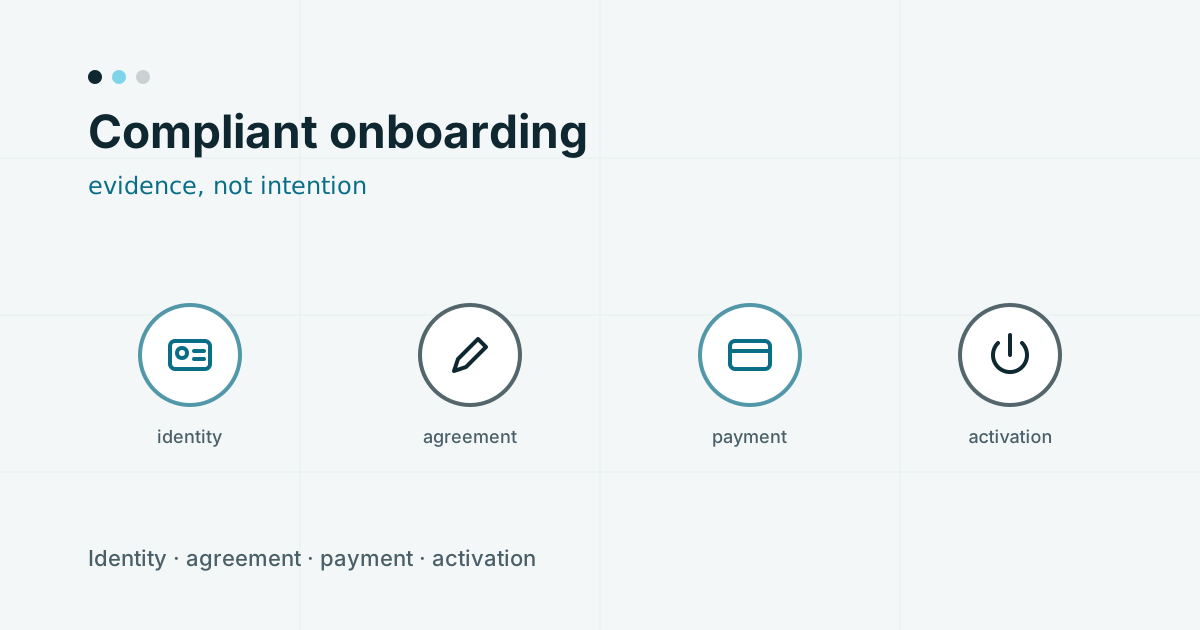
"Is your onboarding SEBI compliant?" is a question RAs hear from vendors, auditors and their own compliance advisers. It is usually answered with a list of steps: KYC, agreement, payment. That list is necessary, but it misses the point.
Onboarding is judged later. A client complains six months in, an inspection asks for a sample of files, a payment is disputed. At that moment, the question is not whether your process had the right steps. It is whether you can prove, with dates, that each step happened for this client.
So the useful definition is: compliant onboarding is a sequence that produces evidence as a side effect.
The four pieces of evidence
For each new client, you want to be able to produce four things without searching:
- Who they are, checked against an official record, not just typed in.
- What they agreed to, the exact document, with when and how they accepted it.
- What they paid you, through which channel, with a proper invoice.
- When they became active, and that it happened only after the first three existed.
Everything below is about producing those four reliably.
Identity: check the PAN, and take the name from the record
Collecting a PAN is easy. Checking it properly means verifying it against the KYC Registration Agency (KRA) record at the point of entry, and then using the name that comes back, rather than the name the client typed.
The second part sounds pedantic. It is the single biggest cause of KYC trouble later. People type their names the way they say them: initials expanded, middle names dropped, spellings that differ from their PAN card by one letter. Those mismatches surface weeks afterwards as a rejected KYC, often after the client has paid and started receiving research. Filling the official name from the KRA response removes the problem at source.
Two practical notes:
- Run the check on your own KRA credentials. The verification trail is part of your compliance record and should be in your name.
- Decide what happens when the KRA cannot answer (a timeout, an outage). A confident mismatch should stop the flow. A missing answer usually should not; flag it for your team and let the client continue.
Agreement: show it, then capture acceptance properly
The MITC and your terms are only as useful as your ability to show the client saw them.
Good practice:
- Present the MITC, agreement and key disclosures in full, not as a link at the bottom of a form.
- Capture acceptance with an electronic signature that records who signed, when, and from which device or IP address.
- Store the signed document itself, the exact version, against the client record. If you revise your MITC next year, you must still be able to show what this client signed.
Some desks go further and record how long the client spent on each document before signing. That is not a regulatory requirement, but it is persuasive evidence if a client later says they never read it.
Risk profiling, where it applies
If your practice documents suitability, or you are also registered as an Investment Adviser, the risk profile belongs in onboarding too: captured once, stored with a date, and linked to what the client is entitled to receive. Revisit it on a schedule, not only when something goes wrong.
Money: your account, your invoice, the fee cap
Three things to get right:
- The money lands in your merchant account. A vendor that collects on your behalf and pays out later is holding client funds, which creates questions you do not want.
- The invoice is yours. Your firm's name, your GSTIN, your number series, your GST treatment (not registered, GST added on top, or GST included).
- The SEBI fee cap is considered before payment. For individual and HUF clients, total research fees are capped per family per year. Checking at checkout is far easier than unwinding a breach at audit.
Activation: gate it on the evidence
The last step is the one most often done wrong. A client should become active, and start receiving research, only once the evidence exists: the KYC is in, the signed agreement is stored, the payment is approved.
It is tempting to activate on a "success" response from an API and assume the document will follow. Usually it does. Occasionally it does not, and you have a paying client receiving research with nothing in their file. Gate activation on the stored artefacts, and accept that a client might occasionally wait a few extra minutes.
Where onboarding usually goes wrong
In our experience, the technology is rarely the bottleneck. The common delays are:
- Missing credentials. Nobody can find the KRA login, or the gateway keys belong to a former employee.
- Unsigned-off documents. The disclaimer has not been approved by compliance, or there are three versions of the MITC in circulation.
- Abandoned sign-ups. A client starts, stops halfway, and is never contacted again.
The last one is a revenue problem as much as a compliance one. Anyone who has verified a phone number or email is a lead. Treat them as one: put them on a list with where they stopped, and follow up.
Before go-live, collect everything in one place: domain, logo, SEBI registration details, GSTIN, gateway keys, KRA credentials, the final MITC and disclaimer wording. Most "onboarding projects" that drag on are waiting for one of these.
Design the flow so clients actually finish it
Evidence only exists for clients who complete onboarding. A flow that is compliant but exhausting loses people at every step, and the ones it loses are often the ones who were ready to pay.
A few design choices make a large difference:
- Show progress. A simple indicator ("Step 3 of 6") stops clients abandoning because they assume the forms never end.
- Ask once. If the KRA returns the client's name and date of birth, do not ask for them again. Every field a client types is a field they can get wrong.
- Work on a phone. Most retail clients will onboard on a mobile browser. Test the whole flow on a mid-range Android phone, including reading and signing a long agreement.
- Let people resume. A client who stops to find their PAN card should be able to come back to the same step, not start again.
- Explain the why. One line under the PAN field ("We check this against the official KRA record so your KYC is not rejected later") turns a hurdle into a reassurance.
None of this weakens the evidence. It just means more clients reach the end of the flow, which is where the evidence is created.
A quick self-audit
Pick three clients who joined last month and try to produce, for each:
- The KRA verification result and the date it ran
- The signed agreement, as signed
- The invoice and the payment record
- The date they became active
If any of those takes more than a couple of minutes, that is where to start.
This article describes good operational practice. It is not legal advice; confirm your specific obligations against current SEBI regulations and with your compliance adviser.
How Mintants handles this
Client onboarding on Mintants runs on your own domain and brand. The PAN is checked against the KRA record on your own credentials, KYC and the risk profile are collected, and your MITC is e-signed with the signed copy filed against the client. Payments go to your own gateway, with GST invoices in your series, and every step leaves a timestamped entry in the audit trail. Clients who stop halfway land on your leads list.
Book a walkthrough to see a client go through it on your brand.