
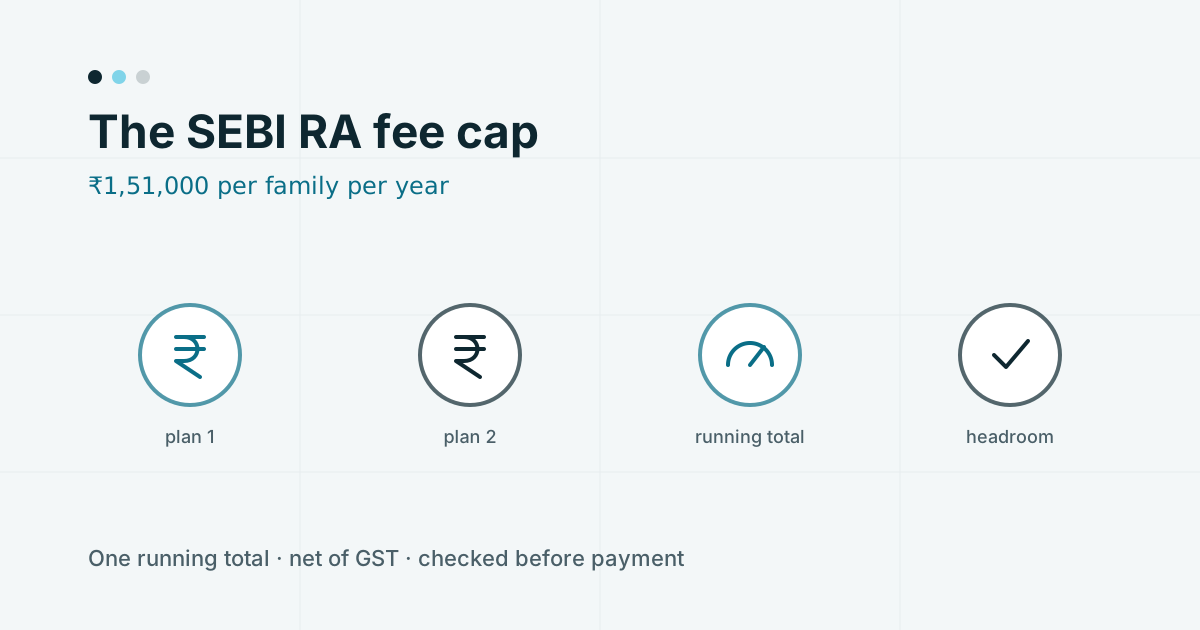
Most Research Analysts know there is a fee limit. Fewer can say, with confidence, how much headroom a specific client has left on a specific morning. That gap is where problems start: not in the rule itself, which is short, but in the arithmetic around it once a client holds two or three plans, has renewed early, and received a partial refund last quarter.
This post walks through the cap the way a desk actually meets it: at the moment a client is about to pay.
This is an operational summary, not legal advice. SEBI revises limits and guidance from time to time. Always work from the current SEBI circular and the figure in your own MITC, and confirm edge cases with your compliance adviser.
The rule in one paragraph
Under SEBI's guidelines for Research Analysts issued in January 2025, the fee an RA may charge an individual or HUF client is capped at ₹1,51,000 per annum per family of client. The figure covers all research services that RA provides to that family, taken together. It excludes statutory charges, which in practice means GST sits on top. Non-individual clients and accredited investors are outside the cap; fees for them are governed by the agreement you sign with them.
That is the whole rule. Everything below is what follows from it.
It is one total, not one limit per plan
The most common misreading is to check each plan against the cap separately. A desk sells an equity plan at ₹70,000 and an options plan at ₹60,000; both are comfortably below ₹1,51,000, so both look fine.
They are not separate. The cap applies to the client (strictly, the family), across everything you sell them. In the example above, the same client buying both plans has used ₹1,30,000 of headroom. If they then add a ₹30,000 model portfolio subscription, the total is ₹1,60,000, and the third purchase breaches the limit even though no single product is expensive.
So the useful question is never "is this plan under the cap?" It is "what has this client already paid us in the last year, and does this cart push them over?"
What goes into the running total
Three adjustments make the difference between a correct number and a misleading one.
Strip GST at your own rate. If your collections are recorded GST-inclusive, take the GST out before comparing against ₹1,51,000. Use the rate you actually charge. A desk that is not GST-registered has nothing to remove; a desk that assumes 18% for everyone will understate what its unregistered peers have collected and overstate the headroom.
Count money received, not money promised. A payment that failed, or a UPI screenshot someone sent on WhatsApp but which never reached your account, is not a fee received. Base the total on approved, settled payments.
Take refunds off. If you refunded part of a fee, the net amount is what the client has paid you. For awkward cases (a plan delivered for two months and then cancelled, a goodwill credit) agree a treatment with your compliance adviser once, write it down, and apply it the same way every time.
"Family" is the part software cannot infer
A PAN identifies one person. It does not tell you that two PANs belong to a husband and wife, or to a parent and a dependent child. The cap, however, is per family of client.
The practical answer is to ask. Add a question at onboarding along the lines of: "Is any member of your family also a client of ours?" Record the answer, link the accounts, and look at the linked total before a large sale. It will not catch everything, but it shows you made a reasonable effort, which is what you will be asked about.
Advance fees and the one-year ceiling
RAs may collect fees in advance if the client agrees, but only for a limited period. At the time of writing, the guidelines allow advance billing of up to one year. Check the current figure before relying on it.
This interacts with renewals in a way that is easy to miss. A client with seven months left on an annual plan who renews today for another year is paying now for access that runs nineteen months out. Whether that is acceptable depends on how your agreement and your compliance adviser treat early renewals. The safe pattern is to let renewals extend the end date but not take payment more than a year ahead of the service it pays for.
Refunds and the mode of payment
Two further points from the guidelines shape the payment flow:
- If service stops before the paid period ends, for whatever reason, the client is owed a proportionate refund for the unexpired period. Your refund process should be able to compute that from the subscription dates, not from someone's estimate.
- Fees must be paid through banking channels: bank transfer, UPI, cheque and similar. Cash is not permitted. SEBI has also made the centralised fee collection mechanism operated through BSE available as a route for clients who want to use it.
Check before the money moves, not at audit
Most desks find cap breaches during an audit or a complaint review. By then the money has been collected, the client has used the service, and unwinding it means a refund, an explanation and a note in your compliance file.
The better place for the check is the checkout itself, before the payment gateway opens:
- Identify the client by PAN.
- Sum their approved payments to your firm over the last 365 days.
- Subtract refunds.
- Remove GST at your own rate.
- Add the cart.
- If the result exceeds the cap, stop and tell the client how much they can still buy this year.
That last step matters. "Payment declined" makes a client think your site is broken. "You can buy up to ₹21,000 more in research services this year" tells them exactly what happened and keeps the conversation open.
If the check cannot get an answer (no PAN on file yet, a slow lookup), decide in advance whether to allow or block. Many desks allow the payment and flag the account for review rather than blocking a genuine new client on a technical hiccup.
A short worked example
A client, Neha, pays you over the year:
| Date | Item | Paid (incl. 18% GST) | Net of GST |
|---|---|---|---|
| January | Equity plan, annual | ₹82,600 | ₹70,000 |
| April | Options plan, 6 months | ₹47,200 | ₹40,000 |
| June | Partial refund, options plan | -₹11,800 | -₹10,000 |
Her running total is ₹1,00,000. Headroom is ₹51,000. If she tries to buy a ₹45,000 model portfolio in August, the purchase goes through and leaves ₹6,000. If she tries to buy a ₹60,000 one, the checkout should stop before payment and tell her the most she can buy is ₹51,000.
Now suppose her husband is also a client and has paid ₹40,000 net this year. If you know they are one family, the headroom is ₹11,000, and both purchases above are blocked. This is why the family question at onboarding is worth asking.
What to put in place this quarter
- Make the cap figure and the advance-fee period visible in your MITC and keep them in sync with SEBI's current numbers.
- Record GST treatment per invoice so the net figure is always computable.
- Ask the family question at onboarding and link related accounts.
- Move the cap check to before payment, with a clear headroom message.
- Keep refunds tied to the invoice line they reverse, so net totals stay accurate.
How Mintants handles this
On the Mintants platform, the client's payments are already on one record: every invoice in your own series, the GST treatment you chose, and every refund against the line it reverses. That makes a client's running total a lookup, not a reconciliation exercise across a gateway dashboard and a spreadsheet.
The cap and advance-fee terms sit in your own MITC, which the client signs during onboarding. Payments go to your own gateway account; Mintants never holds client money.
If you want to see how this looks for your plans, book a walkthrough or see what the platform costs.