
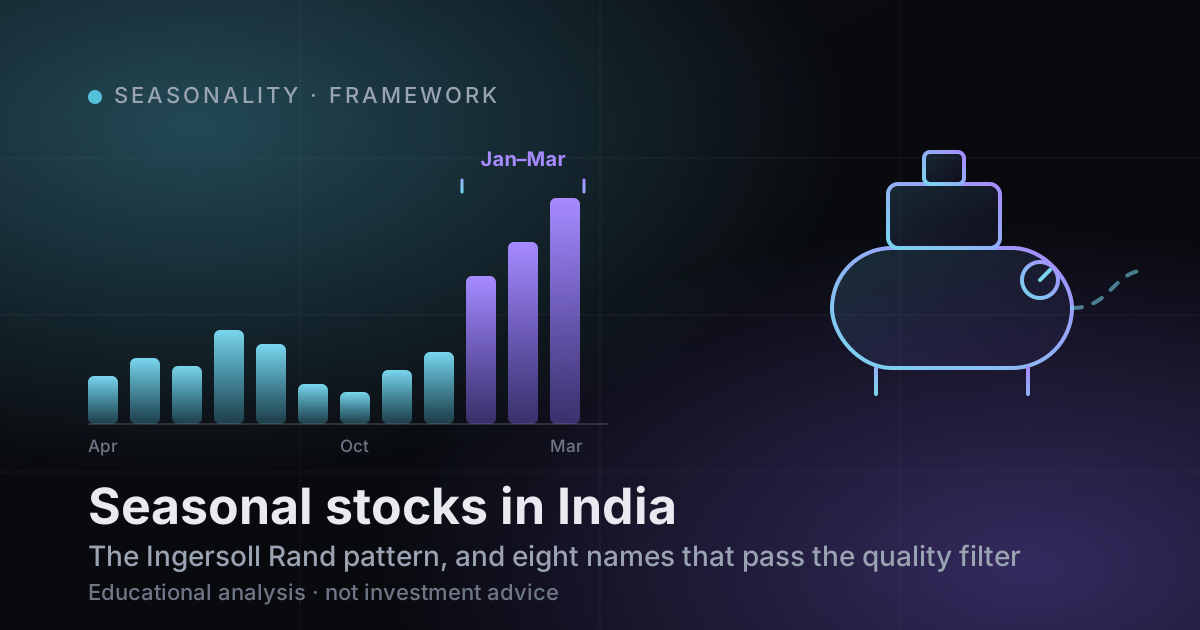
Ingersoll Rand India sells air compressors. It is debt free, earns a return on capital most listed manufacturers never reach, and pays out a large share of what it makes. It also earns a disproportionate slice of its year between January and March, because that is when Indian factories spend the capex budget before the financial year closes.
Look at one quarter in isolation and you will reach the wrong conclusion twice a year. That is true of a whole family of good Indian businesses, and it is the most common way retail investors misread an otherwise clean set of results.
This post is about how to read those companies, and which ones pass a quality filter rather than merely having a seasonal chart.
Educational analysis, not investment advice or a recommendation. The companies here are named to illustrate a pattern, not as a buy list. Seasonality is a property of a business, not a reason to own it. Verify every figure against the latest filings and consult a SEBI-registered investment adviser before deciding anything.
Seasonal is not the same as cyclical
These two words get used interchangeably and they describe very different risks.
| Seasonal | Cyclical | |
|---|---|---|
| Driver | The calendar: weather, harvest, festivals, fiscal year-end | The economy: capex cycles, rates, commodity prices |
| Period | Repeats every 12 months | 3 to 10 years, irregular |
| Predictable | Largely yes | Largely no |
| Correct comparison | Same quarter last year | Peak to peak across a cycle |
| The real risk | The season fails (weak monsoon, cool summer) | The cycle turns |
A tractor maker is both. Sales peak around the kharif harvest every single year, and the whole tractor market still swings across multi-year cycles. Sugar is seasonal, cyclical and policy-driven, which is one reason it rarely belongs in a quality-first portfolio.
The rest of this post deals with the seasonal layer.
Why the market gets seasonal companies wrong
Three mistakes account for most of it.
Comparing quarter to quarter. A capital goods company reporting a September quarter below its March quarter has told you nothing at all. That is the calendar speaking. The only honest comparisons are the same quarter a year earlier, and the trailing twelve months.
Reading the lean quarter as deterioration. Cement volumes fall in the monsoon every year. Air conditioner sell-through collapses in October every year. Headlines about margin pressure in a structurally weak quarter are usually describing weather.
Reading the fat quarter as a re-rating. The reverse error, and the more expensive one. A blowout March quarter at an industrial name is the fiscal year budget flush, not a step change in the business.
Build the habit of pulling four quarters at a time. If a company earns 40% of its profit in one quarter, its trailing twelve-month number is the only figure with any signal in it, and any P/E you compute off a single annualised quarter is fiction.
The Ingersoll Rand template: what makes a seasonal business a good one
Seasonality is dangerous when a company has to borrow to survive its own calendar, and largely harmless when it does not. That distinction is the whole filter.
Ingersoll Rand India is a useful template because it is built to absorb the swing:
- A net cash balance sheet. The inventory and receivable hump before the peak quarter is funded from its own cash, not a working capital line. No lender ever gets a vote in a bad year.
- An installed base. Compressors need spares, service and parts. That annuity revenue lands through the year and covers a good deal of the fixed cost in the lean quarters.
- A parent with a reason to stay. Majority-owned by its global parent, with the technology and product roadmap that comes with it.
- Discipline about the cash. The fat quarter's cash is largely returned rather than spent on unrelated expansion, which is the more common fate.
That gives five tests you can apply to any seasonal name.
| Test | What you are checking | Fails when |
|---|---|---|
| 1. Who funds the hump? | Net cash, or an undrawn facility | Short-term debt spikes every pre-season |
| 2. Does the lean quarter still earn? | Positive EBITDA in the worst quarter | The off-season burns cash every year |
| 3. Is the return real on a full year? | ROCE on trailing twelve months | ROCE only works if you annualise the peak |
| 4. Is there non-seasonal revenue? | Spares, service, AMC, exports, a second segment | 100% of revenue rides one season |
| 5. Where does the peak cash go? | Dividend, buyback, capacity in the core | Diversification into an unrelated business |
Test 1 is the one that actually kills companies. Leverage plus seasonality is how a single bad season becomes a permanent loss of capital, and it is why several otherwise interesting seasonal names sit in the caution list further down rather than here.
India's seasonal calendar
Four separate seasons drive most listed seasonality, and they do not overlap much.
| Quarter | Season | Who peaks |
|---|---|---|
| Q1 (Apr–Jun) | Summer | Air conditioners, coolers, beverages, ice cream |
| Q2 (Jul–Sep) | Monsoon, kharif sowing | Fertiliser, crop protection, seeds |
| Q3 (Oct–Dec) | Festive and wedding, travel season begins | Jewellery, consumer durables, autos, hotels |
| Q4 (Jan–Mar) | Fiscal year-end capex, construction peak, pre-summer stocking | Capital goods, cement, AC channel fill |
Q2 is the awkward one. It is peak season for agri inputs and simultaneously the worst quarter for cement, construction, paint and plumbing, because it rains.
Eight companies that pass the filter
Grouped by which season they ride. Each has, over the long run, run a conservative balance sheet and earned a genuine return across a full year, which is the point of the list.
Fiscal year-end capex, Q4 heavy
| Company | What it sells | Why the season | The quality marker |
|---|---|---|---|
| Ingersoll Rand India | Industrial air compressors | March-quarter capex flush at customer factories | Net cash, high ROCE, service annuity, disciplined payout |
| Cummins India | Gensets, engines, powergen | The same year-end effect, plus pre-monsoon genset stocking | Net cash, long dividend record, exports smooth the domestic swing |
Both are majority-owned by global parents, both have large aftermarket businesses, and both have long records of not needing debt to get through a lean quarter. Neither has been cheap for some time, and that is the standing argument against them.
Summer, Q1 heavy with a Q4 stocking quarter
| Company | What it sells | Why the season | The quality marker |
|---|---|---|---|
| Blue Star | Room and commercial air conditioning, cold chain | Summer sell-through, channel fill in the March quarter | Commercial refrigeration and the projects business earn through the year |
| Havells India | Electricals and fans, plus ACs via Lloyd | Summer for cooling, festive for the rest | Broad product base, brand-led pricing, conservative balance sheet |
The cooling names carry a specific risk worth naming. An early or heavy monsoon truncates the selling season, and the inventory built in March does not clear. Watch inventory days in the June quarter, because that single number tells you whether the summer worked.
Voltas belongs in the same conversation as the volume leader, with a Tata parent, but its execution and margin record through recent summers has been more volatile than Blue Star's. Worth studying rather than assuming.
Monsoon and kharif, Q2 heavy
| Company | What it sells | Why the season | The quality marker |
|---|---|---|---|
| Coromandel International | Fertiliser, crop protection, rural retail | Kharif sowing drives the July to September quarter | Murugappa group, backward integration, strong return on capital |
| Dhanuka Agritech | Crop protection | The same kharif season, plus a smaller rabi peak | Debt free, asset light, high ROCE, no manufacturing-heavy leverage |
| Escorts Kubota | Tractors, construction equipment | Post-harvest cash and the festive buying window | Very large net cash position, Kubota technology and parentage |
Agri names carry a real and unavoidable risk, which is the monsoon. A deficient year is not a deferred sale, it is a lost one, because a crop that was not sown does not get sown later. Fertiliser also carries government subsidy receivables, so read the working capital section and not just the P&L.
Festive, wedding and travel, Q3 heavy
| Company | What it sells | Why the season | The quality marker |
|---|---|---|---|
| Titan | Jewellery, watches, eyewear | Diwali, Dhanteras and the wedding calendar | Exceptional return on capital, Tata parent, franchise pricing power |
| Indian Hotels (IHCL) | Hotels, food and beverage, brand management | October to March is the Indian travel and banqueting season | Deleveraged balance sheet, asset-light management contracts growing |
Titan's Q3 skew is partly the festive quarter and partly the wedding dates, which move each year. When Q3 disappoints, check the number of auspicious dates before concluding anything about demand. IHCL's seasonality is amplified by operating leverage: a hotel's costs are largely fixed, so occupancy swings hit profit far harder than they hit revenue.
Deliberately, there are no valuations in these tables. Several of these names have traded at demanding multiples for years, and a good business bought at the wrong price is still a bad investment. This is a quality screen, not a purchase order. Pull current P/E, ROCE and debt figures yourself before acting on any of it.
Where seasonality turns dangerous
The same revenue pattern, without the balance sheet behind it, is a different asset entirely.
| Trap | Why it looks attractive | Why it usually is not |
|---|---|---|
| Sugar mills | The crushing season creates a visible surge | Cane price, ethanol policy and export quotas are set by government, not management |
| Leveraged contract manufacturers | Explosive growth in the peak quarter | Debt-funded working capital plus one weak season equals covenant trouble |
| Single-product, single-season names | A pure play on the season | Nothing earns in the other nine months, and one cool summer wipes out the year |
| Poultry and protein | Sharp winter demand | Feed cost is a commodity and disease risk is uninsurable |
| Fireworks and seasonal fads | One enormous quarter | Regulation, and no repeat purchase to build a franchise on |
Amber Enterprises is the honest example of rows two and three together. It is a genuinely capable air-conditioner contract manufacturer with real customers, but it carries working capital debt into a season it does not control, which makes it a fundamentally different risk from Blue Star even though both sell into the same summer.
Symphony is the cautionary version of the single-season problem. Air coolers, almost entirely one season, a net cash balance sheet that passes test 1, and a growth record that has struggled precisely because there is no second engine.
How to read a seasonal company's results
A short checklist for the quarter itself.
- Compare to the same quarter last year. Never to the previous quarter.
- Compute trailing twelve months for revenue, EBITDA and PAT. That is the real business.
- Read inventory days in the quarter after the peak. A build that did not clear is the first and clearest sign the season failed.
- Read receivable days two quarters after the peak. Channel stuffing shows up here before it shows up anywhere else.
- Check short-term borrowings across the pre-season quarter. If they spike every year, the business is funding its calendar with someone else's money.
- Look at the lean quarter's EBITDA. A company that stays profitable in its worst quarter has a cost structure that respects its own seasonality.
The most useful year to study at any seasonal company is its worst one. Find the deficient monsoon, the cool summer, the muted festive quarter, and read that annual report. How the company behaved when the season failed tells you more than five good years do.
Can you trade the seasonality?
Mostly, no, and this is where a lot of retail money goes wrong.
The seasonal pattern is public, decades old, and visible in every screener. It is priced in. Buying an AC stock in February because summer is coming is a trade that thousands of people place every February, which is precisely why it does not work reliably. What moves these stocks is the deviation from the expected season, and forecasting that is a weather problem, not an investment process.
There is a milder and more defensible version of the idea. Seasonal businesses often report an ugly lean quarter, get written up as slowing, and de-rate on what is simply the calendar. If you have already decided a business meets your quality bar, the off-season tends to be the less crowded time to accumulate it. That is a patience argument rather than a timing one, and it only works if the quality work came first.
The failure mode to avoid: a seasonal dip and a cyclical downturn look identical in a single quarter. The way to tell them apart is the same-quarter-last-year comparison. If this September is below last September, the calendar is not your explanation.
The bottom line
Seasonality is not a strategy. It is a characteristic, and its main practical use is defensive, in that it stops you misreading a perfectly healthy company four times a year.
The businesses worth owning through their season share the handful of traits that Ingersoll Rand India illustrates. They fund their own working capital hump, they earn something in the quiet quarters, they have revenue that does not depend on the weather, and they return the peak quarter's cash instead of chasing it into something new. Companies with the same seasonal chart and none of those traits are a different investment altogether, however similar the revenue pattern looks.
Get the quality question right first. The calendar is the easy part.
Ready to put this into practice?
Open a free demat & trading account with Enrich Money and start investing in minutes.
Enrich Money is a third-party SEBI-registered broker. This is a referral link and we may earn a benefit if you open an account. Opening a demat account is your decision and not investment advice.
Want a compliance-first framework for screening businesses this way? That is what the Mintants advisory platform is built for. You can also start a conversation.
Educational analysis only, not investment advice or a recommendation. Company mentions illustrate a framework and are not endorsements. Business fundamentals and valuations change, so verify against the latest filings. Consult a SEBI-registered investment adviser before making financial decisions.