
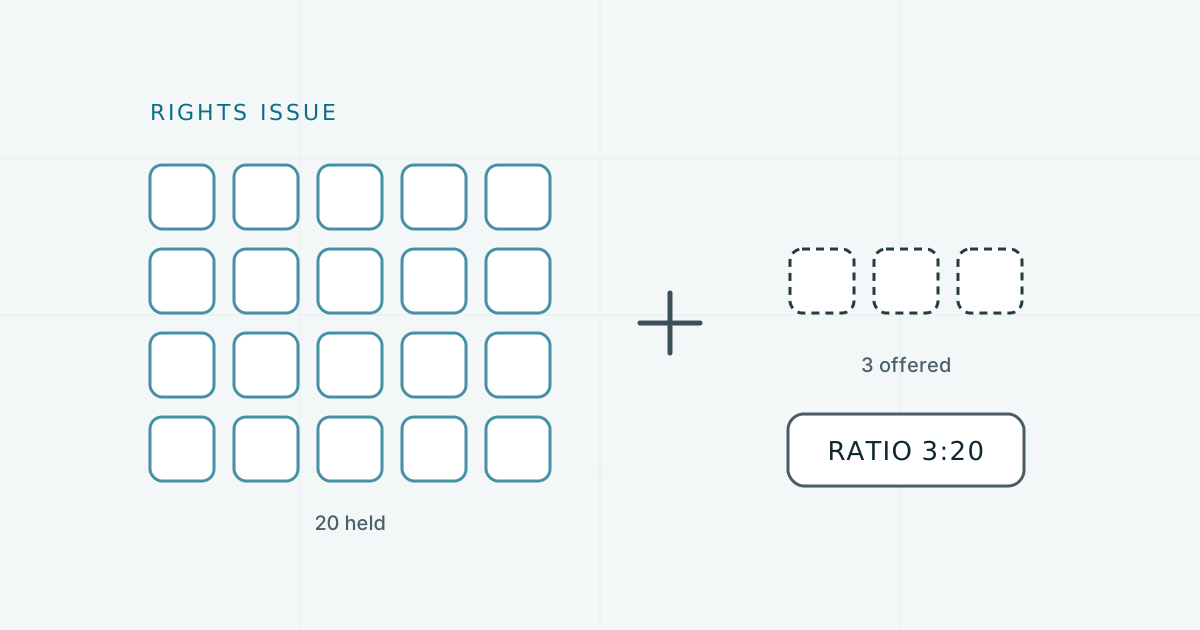
A rights issue is a company asking its existing shareholders for more money. It offers them new shares, in proportion to what they already hold, usually at a price below the market. That discount makes rights issues look like a gift. They are not, and understanding why is most of what you need to know to handle one well.
What a rights issue is
When a listed company needs capital, to pay down debt, fund expansion, or shore up a weak balance sheet, it has a few options: borrow, place shares with institutions, or go back to the people who already own the business. A rights issue is the third route.
Every shareholder on the record date gets the right, but not the obligation, to buy new shares at a fixed rights price, in a fixed ratio to their holding. Because everyone is offered the same proportion, a shareholder who subscribes in full keeps exactly the same percentage ownership of the company as before.
Reading the terms
Every rights issue announcement comes down to a handful of numbers.
| Term | What it means |
|---|---|
| Ratio | New shares offered per shares held. 3:20 means 3 new shares for every 20 you own. |
| Rights price | The price you pay per new share, fixed by the company. |
| Record date | The date the company checks its register to decide who is eligible. |
| Ex-date | The first day the share trades without the right attached. Buy on or after this date and you do not get the entitlement. |
| Rights entitlement (RE) | The right itself, credited to your demat account as a separate security. |
| Renunciation | Selling or transferring your REs to someone else instead of using them. |
With India's T+1 settlement, the ex-date and the record date fall on the same day. To be eligible you must buy the shares at least one trading day before the ex-date, so the trade settles into your demat account by the record date.
How the process runs
- Board approval and offer document. The company announces the issue size, ratio, price and record date, and files a letter of offer.
- Record date. Eligible shareholders are fixed.
- Rights entitlements credited. REs appear in your demat account under a separate ISIN, typically before the issue opens.
- Issue opens. For the period it is open, you can apply, usually through your broker's or bank's ASBA facility, where the money is blocked rather than debited.
- RE trading window. REs can be bought and sold on the exchange for part of the offer period. This is how you renounce: you sell the right to someone who wants it.
- Allotment and listing. New shares are allotted, credited to demat, and start trading alongside the existing ones.
Most shareholders also get a chance to apply for additional shares beyond their entitlement. These are allotted only if others leave theirs unsubscribed.
The discount is not free money
This is the part that trips people up. Suppose a share trades at ₹100 and the company offers 1 new share for every 4 held at ₹60. That 40% "discount" looks like an easy profit.
It is not, because the company is selling new shares cheaply, which dilutes every existing share. Once the issue is done, the market price adjusts towards the theoretical ex-rights price (TERP):
TERP = (existing shares × market price + new shares × rights price)
       ÷ (existing shares + new shares)
In the example: (4 × 100 + 1 × 60) ÷ 5 = ₹92.
If you subscribe, you hold 5 shares worth ₹92 each (₹460), having paid ₹400 + ₹60. You are exactly where you started. If you ignore the offer, you still hold 4 shares, but they are now worth ₹92 each: you have lost ₹32 of value, transferred to whoever took up the cheap shares.
Doing nothing is the one choice that reliably costs you money. If you do not want to invest more, sell your rights entitlements during the RE trading window. Unexercised REs simply lapse at the end of the issue, worthless.
Your three real choices
- Subscribe. Pay the rights price and keep your full ownership percentage. Makes sense if you still believe in the business and the reason for raising money.
- Renounce (sell the REs). Take cash for the right instead. You end up with a smaller slice of the company, but you are compensated for the dilution, roughly.
- Partial. Subscribe to some, sell the rest. Useful when you want to stay invested without adding the full amount.
And the fourth option, letting the REs lapse, is the one to avoid.
Questions to ask before you subscribe
The ratio and discount tell you the mechanics. Whether to put in more money is a question about the business.
- Why is the company raising money? Funding a specific expansion with a clear return is very different from plugging losses or repaying debt that should never have been taken.
- Is the promoter subscribing? Promoters taking up their full entitlement, or more, is a signal of confidence. Promoters renouncing is worth asking about.
- How big is the issue relative to the company? A large ratio (say, close to 1:1) is a major recapitalisation, not a routine top-up.
- Is this a repeat? Companies that come back to shareholders every year or two often have a business that does not fund itself.
Upcoming rights issues
The table below lists rights issues with an upcoming ex-date, as shown on Screener's upcoming rights page on 15 October 2026. "% Diff" is the discount of the rights price to the current market price.
| Company | Ex-date | Ratio | Rights price (₹) | Current price (₹) | % Diff |
|---|---|---|---|---|---|
| Shraddha Prime | 15 Oct 2026 | 3:20 | 160.00 | 165.45 | 3% |
| Shivam Autotech | 15 Oct 2026 | 19:25 | 12.00 | 16.97 | 29% |
This list changes daily, and both of these issues went ex-rights on the date above, so buying the shares now no longer brings the entitlement. Existing holders can still act through the RE trading window or by applying. For the latest list, check the Screener page and the company's letter of offer on the NSE or BSE website.
The two rows also show why the discount alone says little. Using the TERP formula on the prices above:
- Shraddha Prime (3:20 at ₹160): (20 × 165.45 + 3 × 160) ÷ 23 ≈ ₹164.7. The rights price is barely below market, so dilution is minimal and so is any "bargain."
- Shivam Autotech (19:25 at ₹12): (25 × 16.97 + 19 × 12) ÷ 44 ≈ ₹14.8. A deep discount on a large ratio: nearly 0.8 new shares for every share held. A shareholder who neither subscribes nor sells their REs would see the value of their holding fall by roughly 13%.
The bigger the discount and the larger the ratio, the more it matters that you act, one way or the other.
Want to take part in rights issues?
Rights entitlements are credited to your demat account. Open a free demat & trading account with Alice Blue to hold shares and apply through ASBA.
Alice Blue is a third-party SEBI-registered broker. This is a referral link and we may earn a benefit if you open an account. Opening a demat account is your decision and not investment advice.
This article is for education, not investment advice. Rights issue terms, dates and eligibility are set out in each company's letter of offer; read it, and consider your own situation, before deciding.