
India is one of the largest buyers of gold jewellery in the world, and for most of its history that market was run by local, family-owned jewellers. Over the last two decades a handful of organised, listed chains have been taking share from them, and their stocks have become some of the most watched consumer names on Dalal Street.
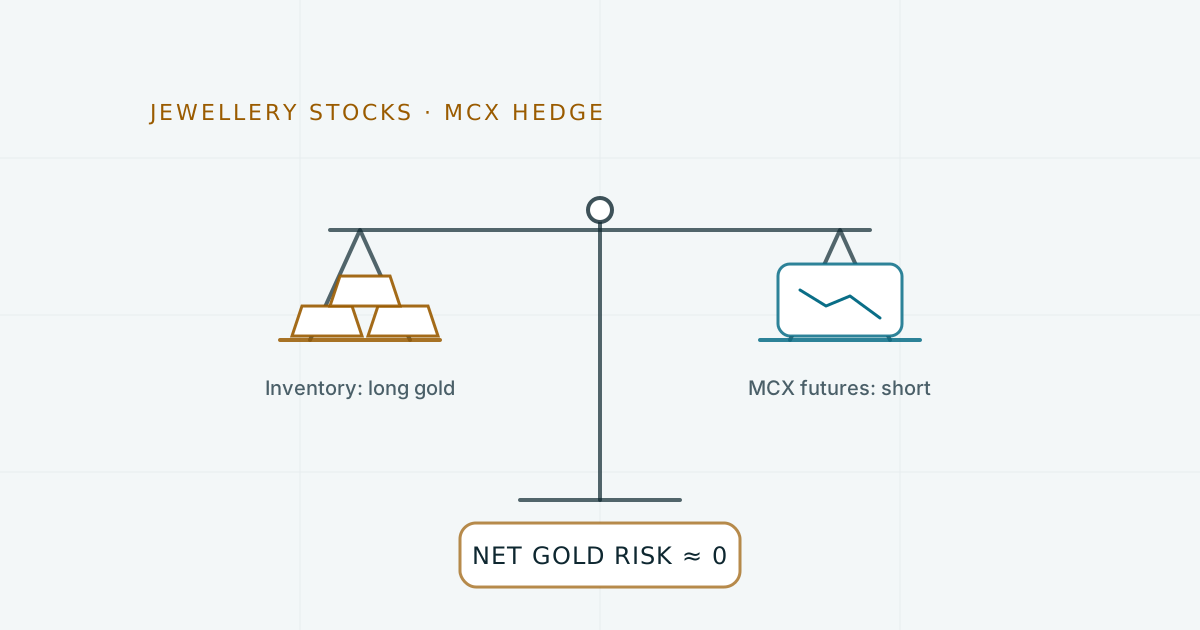
They are also easy to misread. A jewellery company looks like a bet on gold prices, but the best-run ones work hard to make gold prices not matter. Understanding how, and the role MCX plays in it, is the key to reading these businesses well.
The listed jewellery universe
The sector ranges from one of India's most valuable consumer companies to small regional chains. Some of the names investors track:
| Company | What it is |
|---|---|
| Titan Company | Owner of Tanishq, Mia and CaratLane. Jewellery is the bulk of its revenue. The sector benchmark. |
| Kalyan Jewellers | Pan-India chain with a strong South Indian base, expanding through franchise-owned showrooms. |
| Senco Gold | Large organised jeweller rooted in eastern India. |
| P N Gadgil Jewellers | Long-established Maharashtra brand, listed in 2024. |
| Thangamayil Jewellery | Tamil Nadu-focused regional chain. |
| BlueStone | Omnichannel, design-led brand with a large online business. |
| Sky Gold, Motisons, RBZ and others | Smaller manufacturers and regional retailers, some largely B2B. |
This is a list of names to research, not a recommendation. These companies differ widely in size, profitability, debt and how they manage gold risk, which is exactly what the rest of this article helps you compare.
Why organised jewellers keep gaining share
The structural story behind the sector rests on a few shifts:
- Hallmarking. Mandatory BIS hallmarking (HUID) made purity verifiable, removing one of the old advantages of the trusted local jeweller and rewarding brands that were already compliant.
- Trust and transparency. Clear pricing, buy-back policies and exchange programmes matter for a purchase that is both an ornament and a store of savings.
- Formalisation. GST, PAN requirements on large purchases and tighter rules on cash have raised the cost of operating informally.
- Weddings and lightweight jewellery. Wedding demand is steady across cycles, while younger buyers favour lighter, everyday designs and diamonds, where brands have an edge.
How a jeweller actually makes money
The single most important thing to understand: a jeweller's margin is not on the gold. Gold is a pass-through. Customers pay the day's gold rate for the metal, and the jeweller earns on top of it through:
- Making charges, the labour and design premium on each piece.
- Studded jewellery, where diamonds and gemstones carry much higher margins than plain gold.
- Wastage and other charges, still common in parts of the market.
So a ₹1 lakh gold necklace and a ₹1 lakh diamond pendant can have very different profit attached. When you read a jeweller's results, the studded share of revenue often tells you more about margins than total sales do.
Why gold prices cut both ways
A jeweller holds a lot of gold: in showrooms, in transit, at karigars, in the vault. Months of sales can sit as inventory. That creates two very different effects when gold prices move.
When gold rises:
- Inventory bought at lower prices is sold at the higher rate, so reported margins get a one-time boost (an inventory gain).
- Revenue rises with the price, even if fewer grams are sold.
- But buyers may delay purchases or shift to lighter pieces, so volumes can fall.
When gold falls:
- Inventory is now worth less than it cost, and margins get squeezed.
- Buyers often return, since lower prices pull demand forward.
A quarter with "record margins" during a gold rally may mostly be inventory gains that will not repeat. Look for how much of the margin came from gold price movement versus the core business, which most listed jewellers discuss in their earnings calls.
A jeweller that leaves its inventory fully exposed to gold prices is, in effect, running a leveraged gold trade alongside its retail business. That is why the better-run companies hedge.
The two main tools: gold metal loans and MCX
Gold metal loans (GML)
Instead of buying gold outright, a jeweller can borrow physical gold from a bank, use it to make and sell jewellery, and repay the loan later by paying the gold price on the repayment date. Because the cost of the gold is fixed only when it is sold to the customer, the inventory is naturally hedged. Interest on GMLs is also typically far lower than on rupee working-capital loans.
Large players lean heavily on this route. The limits are that GMLs need bank lines, which smaller jewellers may not get, and they cover only part of inventory.
Gold futures on MCX
The other route is the Multi Commodity Exchange (MCX), India's main commodity derivatives exchange. A jeweller that owns gold outright can sell gold futures of a similar quantity. If gold falls, the inventory loses value but the short futures gain, and the two roughly cancel out. If gold rises, the opposite happens. Either way, the jeweller's profit comes back to what it should be: making charges and studded margins.
MCX gold contracts at a glance
MCX lists several gold futures with different lot sizes, so both large firms and individuals can match their exposure.
| Contract | Lot size | Price quoted per | Typical user |
|---|---|---|---|
| GOLD | 1 kg | 10 g | Large jewellers, bullion dealers |
| GOLDM (Gold Mini) | 100 g | 10 g | Mid-size jewellers, traders |
| GOLDTEN | 10 g | 10 g | Small jewellers, individuals |
| GOLDGUINEA | 8 g | 8 g | Small hedges |
| GOLDPETAL | 1 g | 1 g | Individuals, very small hedges |
Silver has the same structure, with SILVER (30 kg), SILVERM (5 kg) and SILVERMIC (1 kg). MCX also offers options on gold futures for those who want protection without giving up the upside.
MCX gold prices include import duty but exclude GST, so they track the landed price of gold in India rather than the international price. Contract specifications, margins and delivery rules change from time to time; always confirm the current ones on the MCX website before trading.
A worked example: hedging 1 kg of inventory
Here is how a small jeweller might hedge. The prices are illustrative.
A jeweller holds 1 kg of gold in stock, bought when gold was ₹1,20,000 per 10 g. That is ₹1.2 crore of inventory. They expect to sell it over the next two months and are worried about a price fall.
The hedge: sell 10 lots of GOLDM (10 × 100 g = 1 kg) at ₹1,20,000.
Scenario 1: gold falls to ₹1,10,000.
| Change | |
|---|---|
| Inventory value (1 kg) | −₹10,00,000 |
| Short GOLDM futures (10 lots) | +₹10,00,000 |
| Net | ≈ ₹0 |
Scenario 2: gold rises to ₹1,30,000.
| Change | |
|---|---|
| Inventory value (1 kg) | +₹10,00,000 |
| Short GOLDM futures (10 lots) | −₹10,00,000 |
| Net | ≈ ₹0 |
In both cases the gold price move is neutralised. The jeweller gives up the windfall in Scenario 2 in exchange for being protected in Scenario 1. That is the trade-off of every hedge: you are buying certainty, not profit. As the jewellery is sold, the jeweller buys back an equivalent number of lots to unwind the hedge.
The reverse hedge: locking in a future purchase
Hedging is not only for sellers. A family planning a wedding in six months, or a jeweller with an advance order to fill, faces the opposite risk: gold getting more expensive before they buy. They can buy gold futures today (GOLDPETAL or GOLDTEN for small quantities, GOLDM for larger ones). If gold rises, the futures profit offsets the higher price paid at the counter.
What can go wrong with a futures hedge
A hedge on paper is clean. In practice there are a few things to manage.
- Mark-to-market and margin. Futures are settled daily. In Scenario 2 above, the short position loses money every day gold rises, and the jeweller must top up margin in cash, even though the inventory gain is only realised when the jewellery is sold. A hedge can be correct and still create a cash crunch.
- Basis risk. The futures price and the price the jeweller actually buys and sells at do not move in perfect lockstep, because of purity, local premiums and timing. The hedge reduces risk but rarely removes it completely.
- Rollover. Contracts expire. A jeweller hedging long-term inventory has to roll positions into the next contract, at a cost that depends on the spread between months.
- Delivery. MCX gold contracts can result in physical delivery if held into the delivery period. Most hedgers close or roll their positions before then unless they want the metal.
- Over-hedging. Selling more futures than the gold actually held turns a hedge into a speculative bet on falling prices.
What hedging means if you own a jewellery stock
For an investor, the useful question is not "will gold go up?" but "how exposed is this company to gold prices?" A few things to look for in annual reports and earnings calls:
- Hedging policy. Does the company state what share of its inventory is hedged through GMLs or futures? A higher, consistent hedge ratio means steadier, more predictable earnings.
- Inventory gains disclosed. Companies that separate gold-driven gains from core margins make it easier to see the real business.
- Studded ratio and same-store growth. These show the quality of growth, independent of the gold price.
- Working capital and debt. Jewellery is inventory-heavy. Watch how much borrowing it takes to fund each new showroom.
- Franchise versus owned stores. Franchise-led expansion is lighter on capital but gives the company less control over the store.
Shorting MCX gold is generally not a good way to hedge a holding in a jewellery stock. The share price depends on store growth, margins, demand and market sentiment far more than on gold alone, and a well-hedged jeweller has deliberately reduced its gold sensitivity. Hedging a jewellery stock against gold can leave you exposed in two places instead of one.
Getting started on MCX
To trade or hedge on MCX as an individual, you need a broker that offers commodity trading and the commodity segment activated on your account, which usually means submitting income proof. Start with the smallest contracts, understand the margin and mark-to-market rules before you place a trade, and size any hedge to the gold you actually hold or plan to buy.
Want to invest in jewellery stocks or hedge on MCX?
Open a free demat & trading account with Alice Blue to buy listed jewellery stocks and trade gold futures on MCX from the same account.
Alice Blue is a third-party SEBI-registered broker. This is a referral link and we may earn a benefit if you open an account. Opening a demat account is your decision and not investment advice.
This article is for education, not investment advice. Commodity derivatives are leveraged and can lose more than the margin deposited. Contract specifications are set by MCX and may change; check the exchange's latest circulars, and consider your own situation, before trading.